Sri Narayana Theerthar
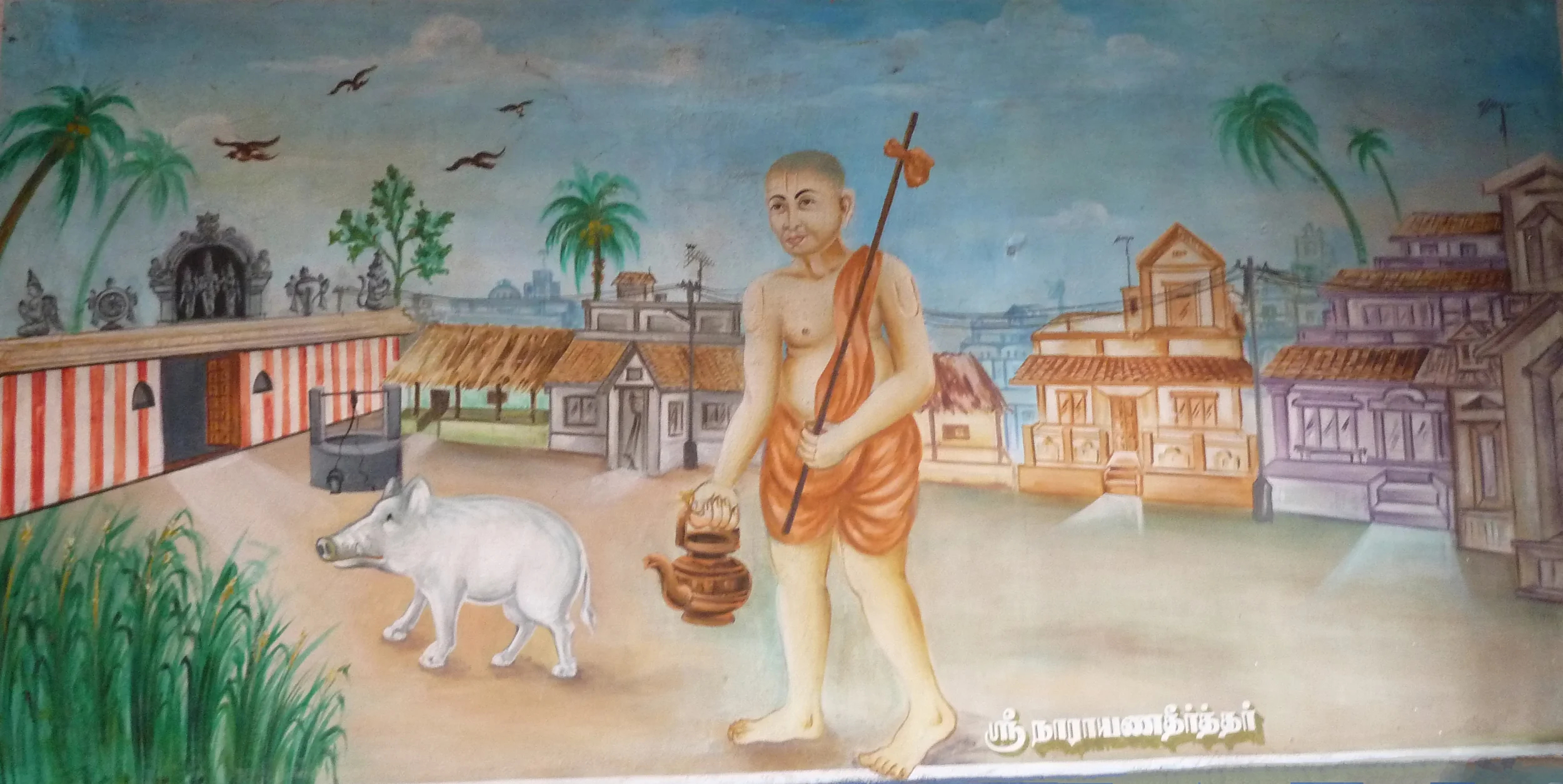
Sri Narayana Theerthar — also written as Narayana Tirtha — was a saint-composer of the 17th and early 18th centuries. He is remembered above all for the Krishna Leela Tharangini, a Sanskrit musical opera in twelve tarangams on the life of Lord Krishna. He spent his last years at Varagur, in Thanjavur district of Tamil Nadu, where he attained Deva Mukthi at the Sri Venkatesa Perumal Kovil.
Early life
He was born in 1675 CE at Kaza, a small village in Guntur district of present-day Andhra Pradesh; the same village is also called Villathur in temple records. His given name was Govinda Shastri. He took sanyasam soon after his marriage and was initiated into the order at Kanchipuram by his guru, Sri Shivaramateertha. The name Narayana Theerthar was given to him at that initiation.
The journey to Varagur
On his guru’s instruction he set out on a long pilgrimage, travelling first to Tirupati and then south into the Cauvery delta. He suffered through these years from a severe stomach ailment that nothing seemed to cure. He came to Govindapuram hoping to meet Sri Bodhendra Swamigal, but Bodhendra Swamigal had attained Mukti only a few months before. He continued his pilgrimage with the same pain and visited many of the small temple villages of the delta.
At Nadukkavery, near Thiruvaiyaru, the pain became unbearable and he lay down in the village’s Vinayaka temple. In a dream, Lord Krishna told him that on waking he would see an animal and should follow it, and that the stomach ache would then leave him. When he woke, the animal he saw was a white pig. The Sanskrit name for pig is Varaha, which is also the form Lord Vishnu had taken as the boar avatar. But seeing a pig at waking is considered inauspicious, and he hesitated. He followed it anyway.
The pig led him about four kilometres south to a village then known as Bhoopathi Rajapuram. There, the pig walked into the local Perumal temple and disappeared. As Sri Narayana Theerthar stood in the temple, he heard the Akashvani of the Lord: “Do not search for me. It was I who brought you here.” His stomach ache left him in that moment. The village, from then on, came to be called Varahapuri — and over time, Varagur.
The Krishna Leela Tharangini
It was at Varagur that Sri Narayana Theerthar composed the Krishna Leela Tharangini, his twelve-tarangam Sanskrit opera on the life of Krishna. The tradition held at the Sri Venkatesa Perumal Kovil is that when he sang the songs in the sannidhi, Lord Venkatesa danced to their tunes. The saint heard the Lord’s ankle bells (salangai oli) as he sang, and Sri Anjaneya played the accompaniment. The Anjaneya Urchavam on the eleventh day of the annual Uriyadi festival is held in memory of this episode.
He is also said to have begun the practice of celebrating Krishna Astami at Varagur as a community festival. That observance is the Uriyadi festival, which has been kept continuously for nearly three centuries.
Deva Mukthi at Varagur
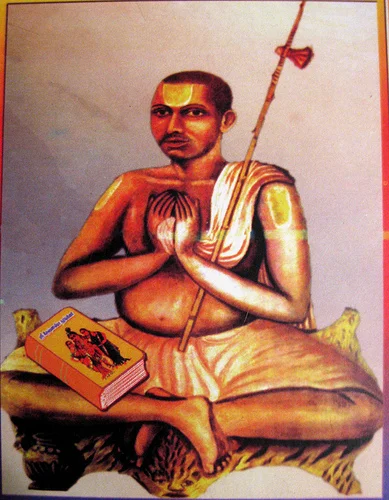
The Varagur tradition is that Sri Narayana Theerthar received the Viswaroopa Darshan of Sri Venkatesa Perumal at the temple and attained Deva Mukthi here, in 1745 CE. This account is preserved by the temple trust and by the families who have served the temple across generations.
Samadhi: Varagur or Thirupoonthuruthi?
Two traditions are held in parallel about where Sri Narayana Theerthar’s earthly life ended.
The first is the Varagur tradition described above: that he received Viswaroopa Darshan of Sri Venkatesa Perumal and attained Deva Mukthi at this temple.
The second is the Thirupoonthuruthi (Tirupoonthuruthy) tradition. A Jeeva Samadhi shrine at Thirupoonthuruthi, in the village of Bhupathirajapuram-Thirupoonthuruthi near Thiruvaiyaru, is widely venerated as the saint’s samadhi. This is the location cited in most external references, including the Wikipedia entry for Narayana Tirtha.
The two accounts do not have to be in conflict. Varagur is remembered as the place of his Viswaroopa Darshan and Deva Mukthi; Thirupoonthuruthi is remembered as the place of his Jeeva Samadhi shrine. Both are venerated. Devotees who follow the Tharangini and the saint’s life often visit both. The two villages, separated by less than fifty kilometres, are part of the same delta tradition.
Sources and further reading
- Madras Heritage and Carnatic Music: Narayana Teertha — biographical sketch with dates and musicology.
- Wikipedia: Narayana Tirtha — short reference entry.
- The temple trust at Sri Venkatesa Perumal Kovil, Varagur — primary-source accounts preserved within the village.
If you have records, photographs, or family memories of Sri Narayana Theerthar that should be added here, please get in touch.
Frequently asked questions
Who composed the Krishna Leela Tharangini?
Sri Narayana Theerthar — a 17th- to 18th-century saint-composer who composed the work in Sanskrit during his years at Varagur.
When did Sri Narayana Theerthar live?
He lived through the 17th and early 18th centuries and is generally held to have attained Mukti in 1745 CE.
Where was Sri Narayana Theerthar born?
In Villathur, in Guntur district of present-day Andhra Pradesh.
Why did Sri Narayana Theerthar come to Varagur?
While on pilgrimage with severe stomach pain, he was instructed in a dream by Lord Krishna to follow a white pig (Varaha) that he would see on waking. The pig led him about four kilometres to the Sri Venkatesa Perumal Kovil at Varagur, where his pain vanished and he heard the Akashvani of the Lord. The village had originally been called Bhoopathi Rajapuram; from then on it was known as Varahapuri, later Varagur.
Where did Sri Narayana Theerthar attain Samadhi?
Two traditions are held in parallel. The widely cited Jeeva Samadhi shrine is at Thirupoonthuruthi (Tirupoonthuruthy) near Thiruvaiyaru. The Varagur tradition is that he received the Viswaroopa Darshan of Sri Venkatesa Perumal and attained Deva Mukthi in this village. Both places are venerated.